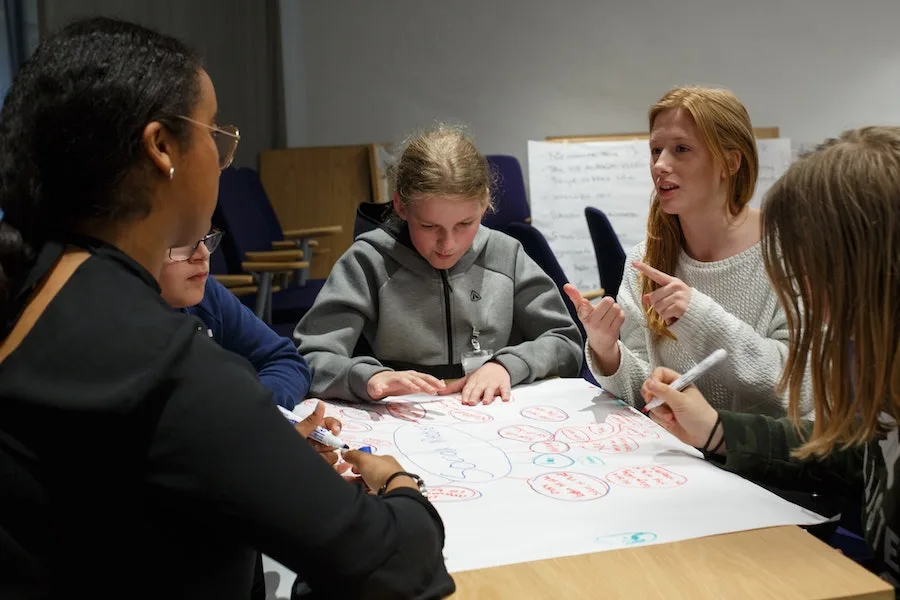
In our three-part Life Skills Series, we’ve shared tips to help you raise critical thinkers and to raise problem-solvers. Now, I’m excited to share ideas around collaborating and working together. Because what the world needs now (besides love, sweet love) is more teamwork to help create more constructive, meaningful, positive change.
So I’ve put together some of my favorite lessons about teamwork that I’ve picked up over the years.
Even if becoming a great teammate takes years (as it does for most of us), these are lessons that kids of all ages can learn and start putting to use right away so that eventually, they become second nature in any collaborative setting.
We hope our 3-part guide will give you even more detailed information on a few of the skills we think are most important, which started with critical thinking, problem-solving, and now, collaboration.
4 simple lessons kids should know to be good collaborators and teammates
1. Good ideas can come from anywhere
Did you think the number one rule should be “be a good listener?”
Well, yes, it should. The problem is, kids don’t always want to listen in a group setting. They can be excited to share their own ideas, or enjoy the attention and feedback of contributing. Which is totally natural.
So instead of telling our kids to simply listen, try explaining why we listen.
Yes, we listen to show respect, which helps build up the entire team. But we also listen because good ideas can come from absolutely anywhere. And if our goal is to solve a problem together or work together collaboratively, we need to be open to those good ideas. We need every single member of the group to not just feel heard, but actually be heard.
If you’re not listening — to everyone — you might just miss out on the big idea you’ve been looking for.
2. The right response to any idea is “yes, and…”
The most important thing I learned while taking a few years of improv classes — besides the fact that I should never be doing professional improv — is the theory of “yes, and….”
The premise is simple: Any idea can be a jumping off point for a great train of thinking. So if you respond to a suggestion with “no…” then you’ve just cut off any opportunity for a germ of an idea to grow into something amazing.
Instead, see how you can build on a suggestion or idea, no matter how silly or weird or impractical or off-topic it may seem at first, just by starting with the phrase, “yes, and…”
For example, say a teammate suggests making a video game to teach kids about recycling. Instead of “no that sounds boring,” or “no, that’s been done,” work on responding with a “yes, and…” sentence.
…yes, and what if we write it like a comedy in the style of Scott Pilgrim?
…yes, and let’s make it 8-bit like we’re back in the 80s, and aliens from the 2020s come to warn us about climate change.
…yes, and wouldn’t it be cool if we get a big celebrity to do the voice over? Who would be perfect?
(I’m sure your kids can come up with better ideas than mine!)
Being the kind of person who can identify the beginning of a great idea (and run with it) can be even more valuable than being the person who comes up with a great idea all on their own.
Related: Raising resilient kids in a world gone sideways: Tips from Dr. Madeline Levine
3. Assists matter
 Photo: Connor Coyne
This idea is often expressed as “the whole is greater than the sum of its parts” but kids may get it better if you talk about soccer.
In soccer, we track assists because it’s an essential contribution toward a goal. Even if you didn’t kick the goal yourself, your pass to the forward may have been the difference between scoring and not scoring and that has value.
It’s the same with other kinds of teamwork and collaboration; kids need to remember that all input is valuable. You don’t have to be the loudest or the leader or the person holding the marker at the whiteboard. Everyone in a group who participates, builds on an idea, refines a solution is essentially passing the ball, no matter who seems to have kicked it in at the end.
Which leads us to the final idea…
4. There’s enough credit to go around
This may be the toughest lesson of all for kids, but if you want to be a real team player and valued collaborator, it’s important that you give credit to everyone.
Kids need to understand that credit is unlimited, and costs you nothing — there’s a reason all those award-winning actors thanks a zillion people until they get played off the stage. They know that to that one person who gets a little shoutout for their work, it means the world.
It’s so important to learn that thanking other people doesn’t take away from your own contributions.
So talk to your kid about being the kind of collaborator who not only sees the value in everyone’s contributions, but is willing to speak up and acknowledge them too. That’s a sure path to becoming the MVP teammate that everyone wants to pick first.
Top image: Edvin Johansson via Unsplash


Leave a Reply