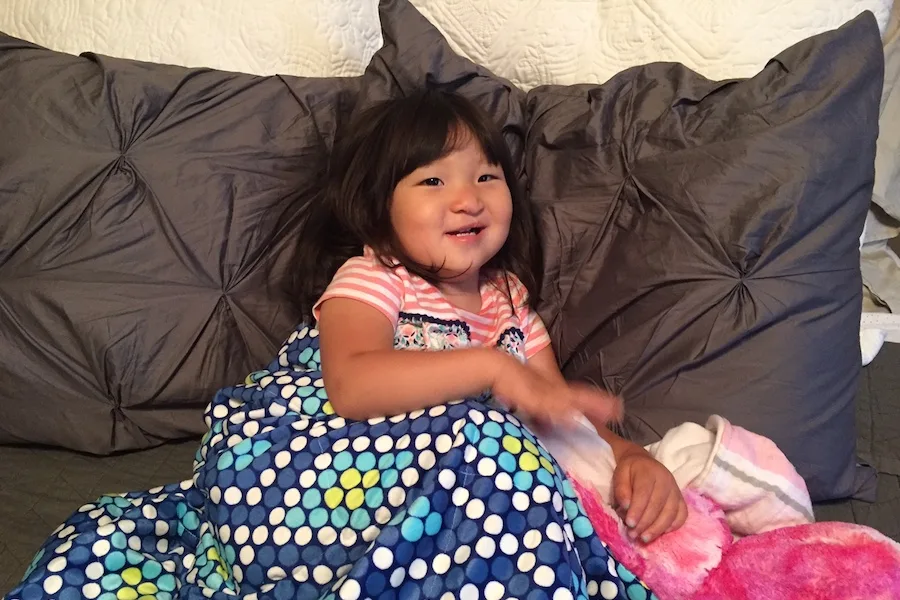
I have a couple of kids with on-and-off sleep issues, so I’ve been paying attention to the swell of discussion about the benefits of weighted blankets for children. These blankets, which are generally filled with anywhere from 5–10 lbs. of weighted beads, are said to help increase both serotonin (which improves your mood) and melatonin (which makes you sleepy).
Basically, your kids feel like they’re being held, which of course makes them happy. And sleepy. Yay!
We recently received a sample weighted blanket from The Magic Blanket for my kids to try out, and after using it for a week or so their bedtime routines were much less stressful. They’re awesome — but oof, not cheap. In fact, on average, kid-sized weighted blankets run about $140 a piece. With four kids, that would putting a serious dent in my summer fun budget.
So, I set out to DIY my own for each kid…for a small fraction of the cost. And came to realize, they aren’t really that hard to make. Now, this isn’t crafting 101, but it’s not advanced tailoring either. If you know how to sew a straight line, you can definitely do this. Promise.
CMP is an rstyle affiliate
Related: Sleep anxiety in kids: 5 solutions for big kid sleep issues that really work
What you’ll need
Of course, in order to pull this off, you’ll need a basic sewing machine (like this one) and have some understanding of how to use it. If you are stuck trying to figure out how to thread your machine or wind the bobbin, check your user’s manual. If you aren’t sure what those things mean, this may not be the craft for you.
Other materials:
– Fabric, of course. I purchased 1.5 yards of 60-inch wide fabric for each side of the blanket, or 3 yards total. UPDATE: There is no one-size fits all blanket. The size, and weight, of your blanket should be the right fit for your child. This size happens to be perfect for my almost 10-year-old.
(Minky fabric is a really popular option because it’s so soft, and if you choose a geometric pattern it will help you out, which I will explain later on. It’s typically around $14.99 a yard. I bought mine at a JoAnn craft store with a 50% off coupon, which they seem to offer constantly, and it saved me a ton of money.)
– 1 spool of all-purpose thread in the same color as the background of your fabric
– A washable sewing marker to mark up the fabric and help guide you while sewing (straight pins work too)
– 5–10 lbs. bag (variable) of weighted beads for the filling. UPDATE: Please note we edited this to highlight that the amount of weighted beads you’ll need will vary from child to child because the weight of the blanket and amount of weighted beads used must be adjusted for the weight of the child. Obviously, the smaller the child, the lighter in weight the blanket should be. You can look up general guidelines for determining the right weight, and size, for your child.
Step-by-step guide to making the blanket
The big picture: Sew a blanket, leaving it open at the top. Next, sew channels along the length of the blanket to fill with weighted beads. Finally, sew rows across the blanket horizontally — as you fill it with the beads — to seal off pockets that will evenly spread the weight across the blanket.
Now, the nitty gritty.
1. Sew two pieces of fabric together in a U shape, leaving the top edge open.
Lay your two pieces of fabric on top of each other, with the decorative sides of the fabric facing each other. Sew a basic seam around the side, bottom, and other side of the fabric, leaving the top edge open. It should be like a huge pocket when you’re done.
Flip the blanket inside out, so that the decorative sides of the fabric are now showing on the outside.
2. Mark 8 vertical channels to fill with beads.
With the fabric marker (or straight pins), mark lines for sewing eight channels that will run the length of the fabric. You have two options: measure the width of the fabric and divide by eight, then measure and mark across the width of the fabric. Or, use the folding method.
To fold, lay the blanket flat and fold in half along the long edge. Mark the fold (the center point of the blanket). Then fold in half again (quarters) and again (eighths), marking the fold creases each time. Unfold the blanket, and you’ll see eight evenly spaced marks for sewing.
3. Sew the channels.
Starting at the bottom (finished) edge of the blanket, sew the vertical lines along the length of the blanket that you marked in step 2, giving you eight vertical channels.
Pro tip: If you choose fabric like mine that has a repeating geometric pattern, it’s much easier to sew straight lines because you can use the design to help guide you.
4. Fill each channel with beads, and sew.
Pro tip: If you used a fabric marker in step 3, wash the blanket before filling with beads to remove the ink. I don’t know if you’d be able to remove fabric marker after completion. I haven’t tried washing my finished blanket yet, but I’d recommend sticking to spot cleaning so that you don’t end up with a washing machine full of weighted beads if a seam busts.
Use a small measuring cup (about 1/8 cup), and add one scoop of beads to each of the channels. (This is much less messy if you put the beads in a bowl first.) Shake well, so they fall to the very bottom of the blanket.
Then, roll the top of the blanket down so that the beads don’t fall out, and sew a horizontal line across the width of the blanket creating a row of pockets (or squares) that seal in the beads.
I tried to space my horizontal lines about the same distance apart as my channels were wide, so that the pockets would be square. So if your channels (vertical seams) are 5 inches wide, then sew the horizontal lines every 5 inches also. This is another place where that geometric pattern on the fabric is helpful in keeping lines straight, so you can choose where to sew based on that too.
5. Repeat step 4 until the entire blanket is filled.
Now, repeat step 4 until you reach the top of the blanket, sealing off the last group of pockets and leaving about 2 inches of raw edge at the top.
Pro tip: Be careful that the outer edges of your blanket are sewn very securely so that no beads can escape, as they could pose a choking hazard.
6. Close the top of the blanket.
Fold the raw edges at the top in toward each other, and stitch one final horizontal seam across the top of the blanket, giving the top edge a finished look.
You’re done!
And you’ve got an extra $100 or so in your pocket to spend on something much more fun, like a new pair of summer sandals. Which you’ve totally earned, by the way.
LAST UPDATED 06/30/17: Please note: While weighted blankets are popular and may be suitable for most ages, from older toddlers/preschoolers to grown ups (my 3-year-old sleeps soundly with hers!), there are some experts who do not recommend them for young children unless under the direction of a therapist. And, of course, weighted blankets are not suitable for babies. If you choose to use a weighted blanket with your child, please make sure the size and weight of the blanket is right for your child. (We made some updates to this post thanks to a Facebook fan’s suggestion of adjusting the weight of the beads based on the weight of the child. Thanks, Lisa, for the smart tip!)
All images © Kate Etue for Cool Mom Picks


Leave a Reply